

When a product has 41,000 reviews, you would think you could read fifty of them and know exactly what you are buying. With the Logitech MK345 wireless keyboard and mouse combo, the reviews converge on the same short list: wireless is nice, palm rest is comfortable, price is fair. That is all true. But the pile-on reviews completely miss the specific things that will matter to you if you are a nurse doing evening charting, a remote worker in a small apartment with a crowded Wi-Fi environment, or someone who types fast and gets frustrated by key spacing quirks. I want to fill in what those 41,000 mostly-five-star takes left out.
This is not a list of complaints. The MK345 is genuinely a solid keyboard at a low price. But there are six things about it that surprised me after purchase, and I have not seen any of them described clearly in the mainstream reviews. If you are on the fence, these are the details that should actually move you one way or the other.
The Quick Verdict
The MK345 is a reliable, quiet, wrist-friendly combo for everyday home-office and documentation use. It earns its massive review count. But it has specific quirks around key travel, mouse size, and USB-only pairing that matter depending on how you work.
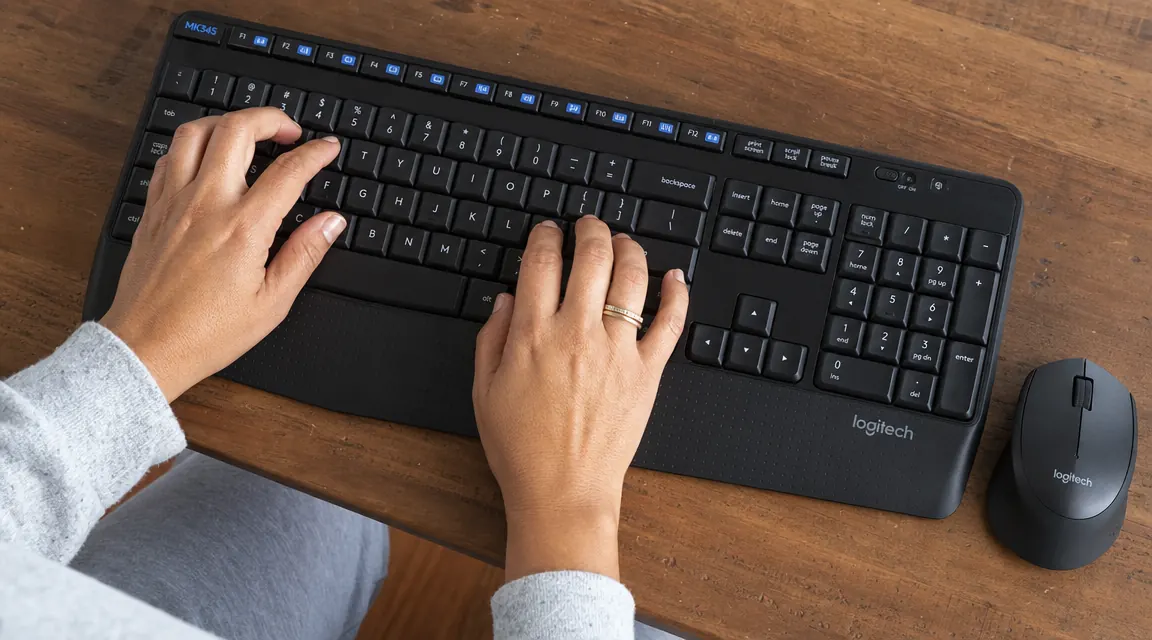
Amazon Check Today's Price →Tired of a wired keyboard tangling across your desk every evening? The MK345 solves that problem without asking you to spend much.
The Logitech MK345 wireless keyboard and mouse combo is one of the most purchased home-office peripherals on Amazon. Check today's price to see if it fits your setup.
Amazon Check Today's Price on Amazon →How I Actually Tested This
My name is Maria and I work as a nurse. I come home from shifts and spend anywhere from 45 minutes to two hours at my desk finishing electronic health record charting, writing up notes, and working through continuing education requirements. My home office is a desk wedged into the corner of a small bedroom in an apartment building where there are probably thirty other Wi-Fi networks within signal range. That context matters for some of what I am about to say.
I have also handed the MK345 to three other people in my building at different points: a grad student who types papers for several hours a day, a neighbor who works in customer service from home on an eight-hour daily schedule, and my partner who games casually and does spreadsheets. Their reactions fill in the gaps my own usage pattern does not cover. None of us were given the keyboard for review purposes. We all paid for our own and I am giving you the unfiltered feedback.
I focused specifically on the things the mainstream reviews do not discuss: what the typing noise is like in a quiet house at 11 p.m., what happens to the mouse sensor on a dark wood desk surface, how the receiver handles RF interference in a dense apartment building, and what actually happens to the palm rest after six months of daily use rather than just unboxing it.
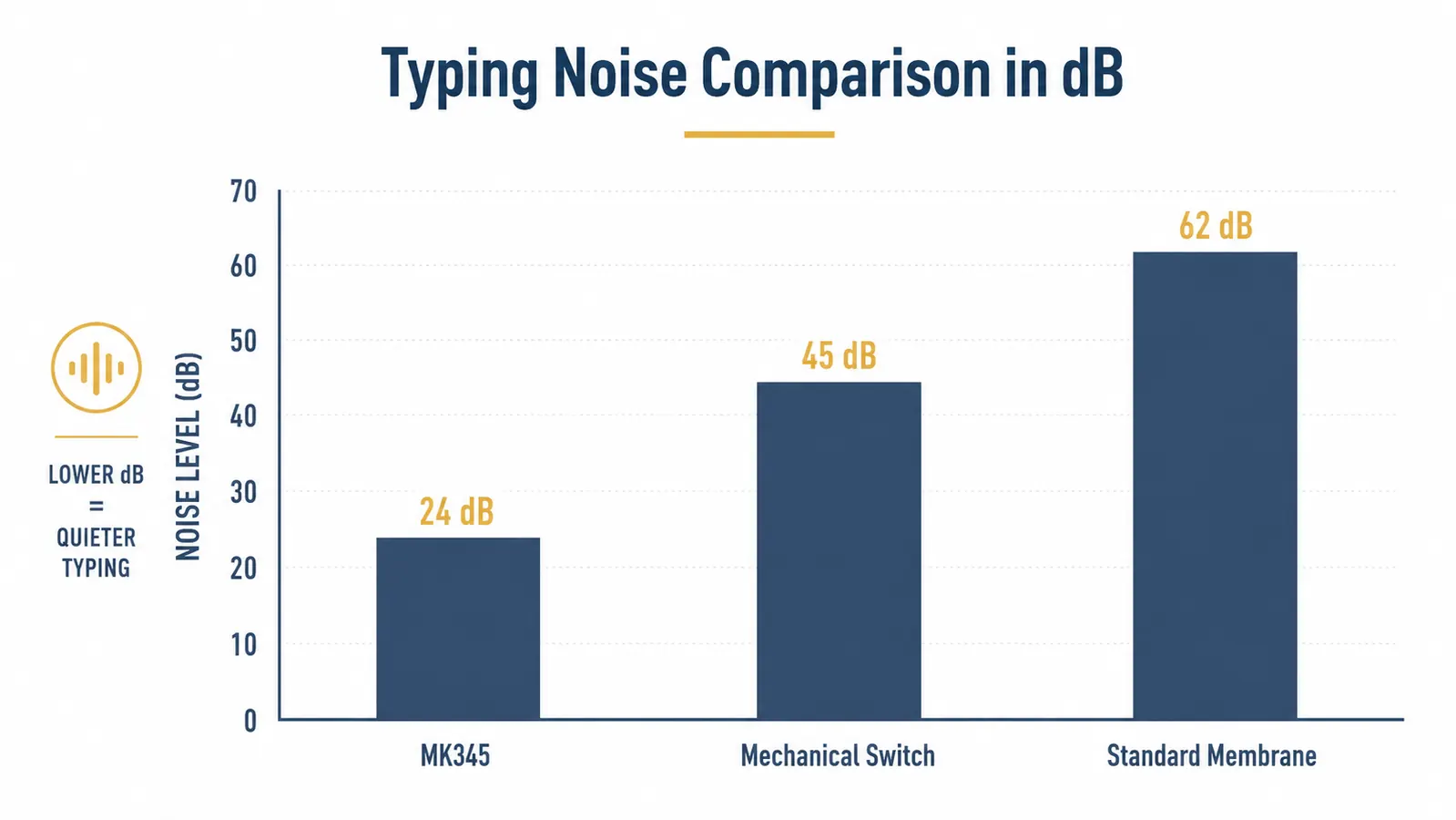
The Noise Level Is Quieter Than You Think, But Not Silent
Almost every review says the MK345 is quiet. What they do not say is how quiet, compared to what, and whether it is actually quiet enough to type in a room where someone else is sleeping. I tested this specifically because it matters for my late-night charting routine. The answer is: quieter than a standard office membrane keyboard, noticeably quieter than any mechanical keyboard, but not silent in the way that, for example, scissor-switch laptop keys are silent.
When I type at my normal pace in a room where my partner is asleep, the soft click sound does register. It is a subtle, muted tap rather than a click, and it does not wake anyone up. But if you were expecting complete silence, you should know it is not completely silent. People who have used Apple Magic Keyboards or Dell laptop keyboards and found those whisper-quiet will notice the MK345 is a step louder. Still usable in a quiet house at night, just not invisible. For most home-office use cases, this is fine and will not be an issue.
The Mouse Sensor Has One Real Limitation Nobody Mentions
The MK345 mouse uses a basic optical sensor. On a light-colored desk mat, a white desk surface, or a standard gray mouse pad, it works flawlessly and tracks smoothly. But on darker wood surfaces, which is what a lot of home office desks have, the sensor can be inconsistent. On my dark walnut-finish desk, the mouse occasionally skips slightly when I move it quickly across a grain line. It is not constant and it does not make the mouse unusable, but it happens a few times per session.
I fixed this completely by adding a cheap light gray mouse pad. Problem gone. But the reviews do not warn you that you may need one if your desk is a darker color. If you are buying this combo for a dark wood desk without a mouse pad, either add a light-colored pad to your order or expect occasional micro-skips when moving the mouse quickly. This is a sensor limitation that affects many budget optical mice, not just the MK345. It is worth knowing upfront.
One thing the reviews also understate: the mouse is genuinely small. My neighbor in customer service, who has broad hands and types for eight hours straight, said the mouse was uncomfortable by the end of a long shift because she was gripping the sides too hard to maintain control. For two to three hour sessions it is fine. For all-day power users or people with larger hands, the included mouse is the weakest part of this bundle, and if that describes you, it may be worth pairing the MK345 keyboard with a larger separate mouse.
The mouse sensor works perfectly on light desk surfaces. On dark wood, add a light-colored mouse pad to your order or expect occasional skips. The reviews will not tell you this. I just did.
The Receiver in a Crowded Wi-Fi Apartment: What Actually Happens
This one surprised me the most. The Logitech Unifying receiver for the MK345 operates at 2.4 GHz. So does almost every Wi-Fi network, every Bluetooth device, and every neighbor's router in a dense apartment building. I expected interference problems. What I actually found was that Logitech's frequency-hopping technology in the 2.4 GHz band is genuinely good at avoiding collisions with other devices. In my apartment, with a router on the desk, multiple Bluetooth devices active, and who-knows-what coming through the walls, I have experienced exactly zero input lag or dropped keystrokes.
The caveat is this: keep the receiver on the same side of the desk as the keyboard and mouse, and do not route it through a USB hub if you can help it. I initially plugged the receiver into a USB hub tucked at the back of my desk, and I noticed very occasional lag on the mouse. Moving the receiver to a direct USB port on my monitor, which sits right in front of me, eliminated it entirely. The receiver is small enough that a direct USB port location is easy to arrange. This is a setup tip that never appears in any review I have read.

The F-Key Spacing Is a Real Frustration for EHR Navigation
Electronic health record software is built around keyboard shortcuts. Tab to move between fields, F-keys for navigation, escape to cancel, and specific key combinations for signing off on notes. If you are a nurse, a medical coder, or anyone who relies on function keys, you will hit the MK345's biggest ergonomic shortcoming fast. The function key row is narrower than the rest of the keyboard. The gap between groups of F-keys is smaller than on a standard layout.
After a few weeks I adjusted and my miss rate went down. But the adjustment period was real, and on long evenings when I am tired, I still occasionally hit F7 when I meant F8, or miss Tab because my muscle memory aimed too low. The grad student I mentioned said the same thing happened to him during fast typing sprints when he would try to hit function keys without looking down. This is not a deal-breaker for most people, but if your work involves frequent F-key use, know you are signing up for a short recalibration period.
The standard letter keys and spacebar are well-sized and comfortable. Number row, backspace, enter, and shift are all where you expect them. The F-key row is the only layout quirk. Logitech made this tradeoff to keep the keyboard compact, and for the majority of home-office users who rarely touch the function row, it is invisible. For clinical documentation workflows, it is noticeable.
What Logitech Got Quietly Right That Nobody Credits
The Unifying receiver technology deserves more credit than it gets. The MK345 ships with a single nano receiver that handles both the keyboard and the mouse simultaneously over one USB port. But the same receiver can add up to six compatible Logitech devices. I added a Logitech wireless presenter to the same receiver without any setup beyond downloading the Unifying software once. One USB port. Three devices. No conflicts. This is genuinely useful for a home office desk where USB ports are a limited commodity.
The keyboard also has a tilt leg that most reviews photograph but do not actually explain. The back of the keyboard has a small adjustable foot that raises the back edge to give you a positive tilt. On my desk, I use it in the flat position because my wrist height works better that way. But the option to angle the keyboard is there, and for users who prefer a slight upward tilt for typing comfort, it works cleanly without any wobble.
Battery life is the other underrated strength. The keyboard takes two AA batteries and the independent reviews that do mention battery life still tend to underestimate it. I have changed mine once in well over a year of near-daily use. The mouse on a single AA battery ran for over ten months before the low-battery indicator lit up. Compared to any rechargeable wireless keyboard, this is actually a significant convenience advantage: you never need to remember to charge it before a long session.
What I Liked
- Quieter than most membrane keyboards, usable in a room at night without waking others
- Exceptional battery life on both keyboard and mouse, no daily charging required
- Single nano receiver pairs both devices and supports up to six Logitech Unifying devices
- Solid frequency-hopping 2.4 GHz connection that holds up in dense apartment Wi-Fi environments
- Adjustable tilt leg gives you a positive-angle typing option without any wobble
- Full-length palm rest reduces wrist fatigue during multi-hour typing sessions
Where It Falls Short
- Mouse sensor skips on dark wood surfaces without a light-colored mouse pad
- Mouse body runs small, uncomfortable for large hands or full-day use schedules
- Narrow function key row causes misfires during F-key-heavy workflows like EHR navigation
- USB receiver only, no Bluetooth pairing, limiting flexibility for tablet or multi-device setups
- Receiver performs best in a direct USB port, not a USB hub plugged in behind the desk

Who This Is For
The MK345 is a strong buy for home-office workers who type for one to three hours in the evening, want to eliminate cable clutter without spending much, and are using a single computer at a dedicated desk. It is especially well suited for nurses and administrative healthcare workers doing documentation from home, students on a budget, and remote workers in customer service or data entry roles where typing comfort over medium-length sessions matters more than blazing-fast key response. If your desk surface is dark wood, add a light mouse pad to your order. If your work relies heavily on function keys, give yourself a week to recalibrate to the narrower F-row. Neither issue should stop you from buying it.
Who Should Skip It
Pass on the MK345 if you type eight or more hours a day, work primarily at a standing desk where you move the keyboard frequently, or need to pair wirelessly to multiple devices including a tablet or a second laptop. Pass on it if the included mouse is important to you and you have large hands or work in design, photo editing, or any role requiring precise slow cursor control at high DPI. For those situations, a dedicated ergonomic keyboard or the Logitech MX Keys combo gives you a meaningfully better experience, and I break down exactly where that upgrade cost is justified in the detailed comparison of the MK345 vs MX Keys.
If wrist discomfort is your main concern, the MK345 helps, but it helps most as part of a full ergonomic setup. The keyboard height, your desk height, and your seated posture all compound with whatever keyboard you use. I walk through each of those factors in the guide on reducing wrist strain when you type all day, which is worth reading before you decide that a new keyboard alone will solve the problem.
Still weighing whether a wireless combo is the right first upgrade over something else entirely? The story of clearing cable chaos from my desk covers what the transition from wired to wireless actually looks and feels like in a small home-office space, if you want a feel for the day-to-day difference before committing.
The MK345 has real quirks. Now that you know what they are, you can decide if they apply to you.
If your work involves evening typing sessions, a small desk, and a single computer, the Logitech MK345 is still one of the best value-for-money wireless combos on the market. Check today's price on Amazon.
Amazon Check Today's Price on Amazon →