

By the end of a twelve-hour shift, my wrists already feel like they have been wrung out. I get home around 10 p.m., sit down at my corner desk, and I still have charting to finish. For years I did that on a wired keyboard I grabbed from a discount bin, the cord catching on my coffee mug every single session. A friend mentioned the Logitech MK345 wireless keyboard and mouse combo and I almost ignored her. It looked basic. The price was almost embarrassingly low. But I was tired and frustrated and I bought it anyway. That was three years ago, and the MK345 is still sitting on my desk right now.
This is a long-term review, not an unboxing take. I have typed thousands of nursing notes on this keyboard, run through two sets of batteries in the mouse, and watched the palm rest develop a slight wear pattern where my right wrist rests. I want to tell you exactly what held up, what surprised me, and what I would change if Logitech asked me directly.
The Quick Verdict
The MK345 is a quiet, reliable, wrist-friendly daily driver that earns its 41,000 reviews. It is not a premium experience, but for charting, documentation work, and everyday home-office use, it delivers real comfort at a price that makes sense.
Amazon Check Today's Price →Still typing on a wired keyboard that yanks across your desk? Here is what three years with the MK345 actually feels like.
The Logitech MK345 wireless combo has been my evening charting keyboard for three full years. Check today's price on Amazon to see if it fits your budget.
Amazon Check Today's Price on Amazon →How I Have Used It
My setup is modest. A 24-inch monitor on a small desk in the corner of the bedroom, a USB hub, and this keyboard-and-mouse combo plugged into a single nano USB receiver. I chart in our electronic health records system, write follow-up notes, and occasionally work through continuing education modules. My sessions run anywhere from 45 minutes on a light night to two-plus hours when I am catching up on a busy week.
I have not babied this keyboard. It has had coffee splashed near it twice (both times it survived), traveled in a tote bag to my parents' house during the holidays, and sat through a summer where the bedroom gets legitimately warm because our window unit barely keeps up. If anything, three years of my real usage pattern is a more useful data point than a lab stress test.
The nano USB receiver has never moved from the port I plugged it into on day one. Connection has dropped exactly zero times. That is the kind of reliability that becomes invisible, which is the best thing a piece of peripheral gear can do.
The Palm Rest: The Feature That Actually Matters
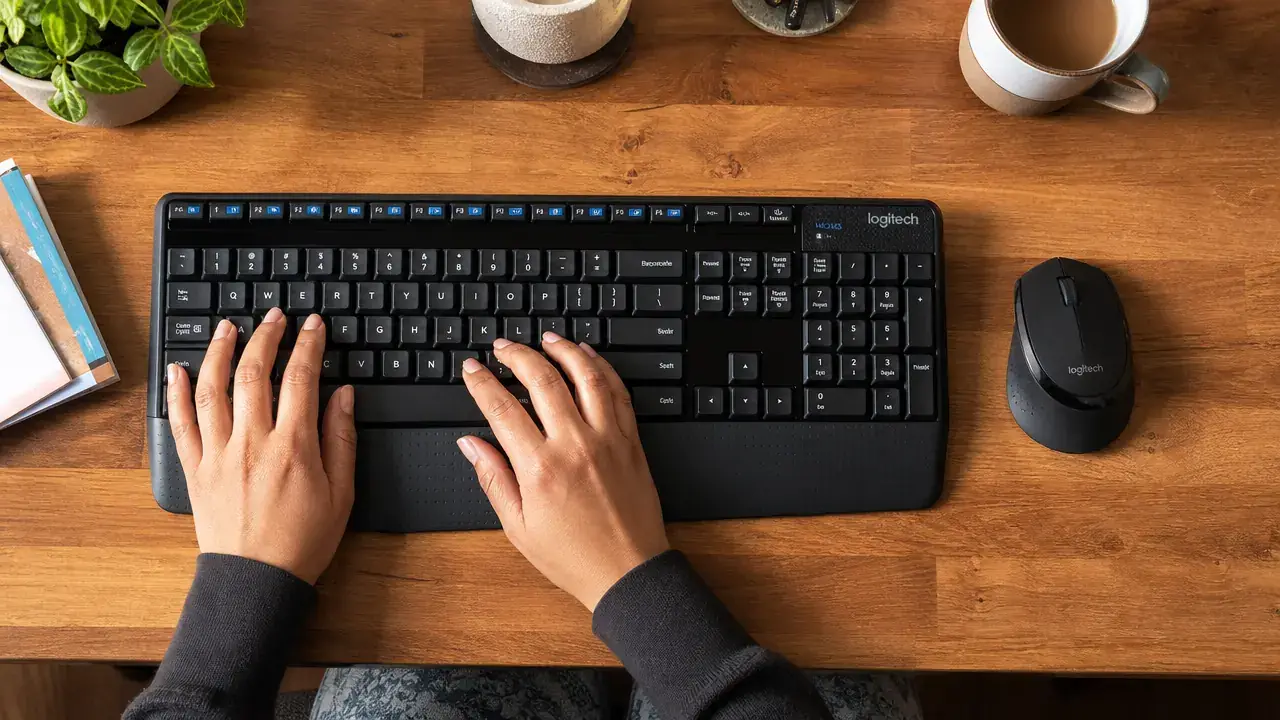
Before I bought the MK345, I did not think much about palm rests. I thought they were a marketing checkbox. Now I think the full-length foam palm rest that runs the entire width of the MK345 keyboard is the single most important detail on this product for anyone who types in long evening sessions.
The rest is attached, not removable. That was a concern I read about before buying, and in practice it has never bothered me. It keeps my wrists elevated just enough to reduce the tension I used to feel by the end of a long charting session. The foam has compressed a bit after three years, which is expected, and it still does its job. I would say it compresses roughly 15 to 20 percent from new, which you could measure if you pressed a ruler into it, but honestly you would never notice in use.
If you are buying this keyboard specifically because of wrist pain, know that the palm rest helps most when your desk height is already reasonable. If your desk is too high, no palm rest fixes that. I pair the MK345 with a desk setup where my elbows are close to 90 degrees, and that combination has eliminated the end-of-session wrist ache I was dealing with before.
Three years in, the palm rest has some visible wear where my wrist rests. That is not a flaw. That is evidence of a product doing its job every single evening.
Key Feel and Typing Noise After Three Years
The MK345 keys are mid-travel, soft-tactile. They are not mechanical and they do not pretend to be. The actuation is quiet enough that I can type at 10 p.m. without waking anyone in the house. This matters more than I expected when I first bought it. The gentle soft-click feel got a bit softer over time, but the keys have not started sticking or skipping, which is the failure mode I worried about.
My only real complaint about the typing feel is the function row. The F-keys are narrower than on a standard keyboard, and I sometimes miss F5 or Tab when I am moving quickly between fields in the charting software. This is a minor thing but it has never fully disappeared as an annoyance over three years. People with larger hands or those who rely heavily on function keys for software shortcuts will notice this more than I do.
The key travel is around 2mm. Not the deepest feel, but deep enough that I do not accidentally trigger keys by resting fingers on them. For a keyboard used almost entirely for documentation and typing, this strikes the right balance between comfort and accuracy.
The Mouse: Compact, Reliable, Not for Power Users
The included mouse is smaller than a traditional full-size mouse and bigger than a travel mouse. It fits my hand in a relaxed grip, though I have medium-sized hands. People with larger hands may find it slightly cramped for marathon sessions. My husband tried it for an hour and said it felt fine for casual use but that he would not want it for a full workday. That is fair context.
What the mouse does well: it moves smoothly on both my desk mat and on bare wood, the two surfaces I use it on. The scroll wheel has a satisfying light resistance. The two main buttons have held up without any double-click issues after three years, which is not a guarantee you can take for granted on budget mice.
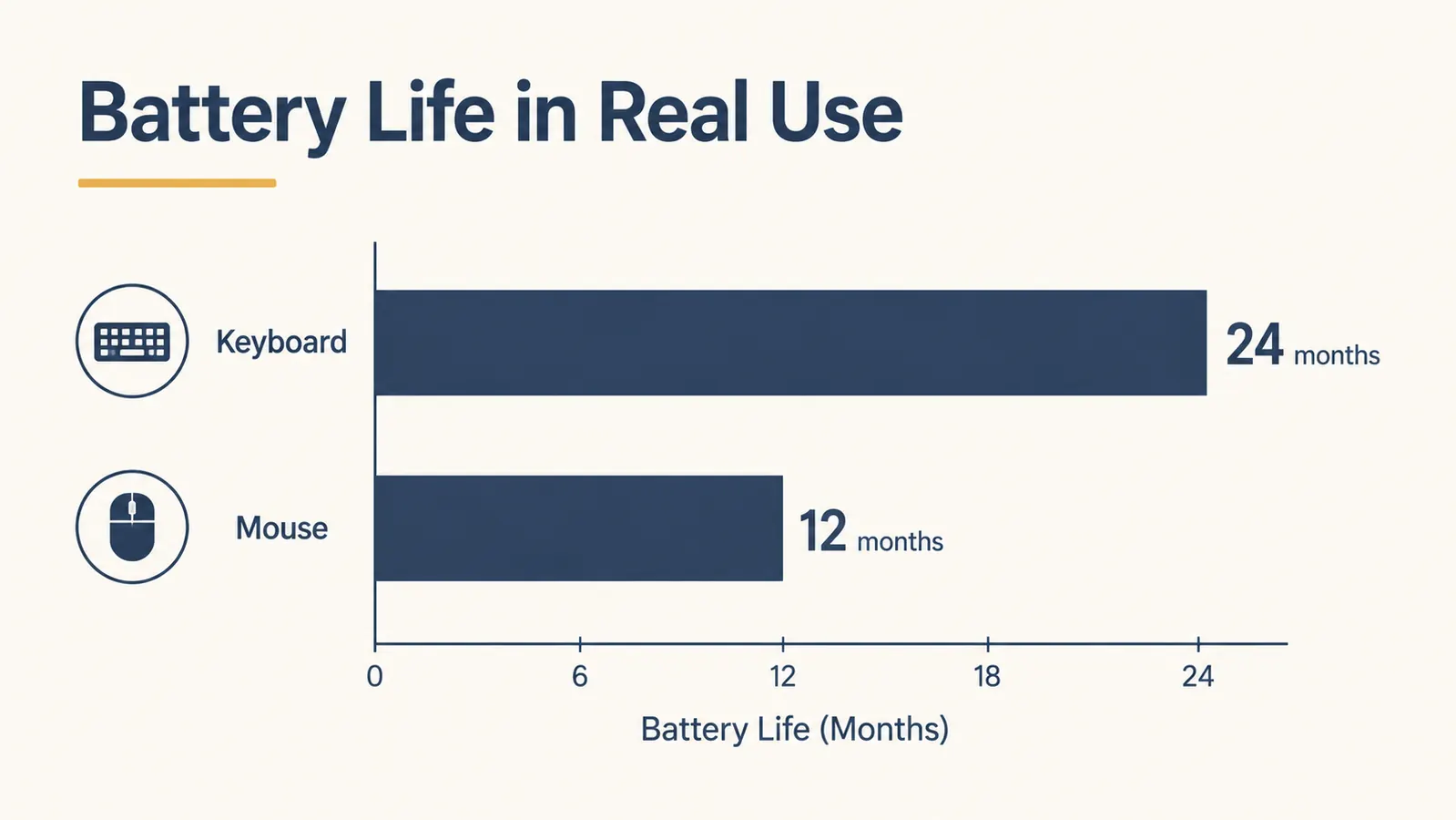
The mouse uses a single AA battery. I got roughly 12 to 14 months on the first battery before the low-battery LED started flashing. The keyboard uses two AA batteries and I have changed them once in three years, at around the 24-month mark. Battery life on this combo is genuinely excellent. I am not thinking about batteries on a regular basis, which is exactly how it should work.

The 2.4 GHz Connection: Set It and Forget It
The nano USB receiver is tiny enough that I leave it plugged in permanently. Logitech calls this a Unifying receiver and it is supposed to connect up to six compatible Logitech devices to a single port. I only use it for the MK345 pair, but knowing that flexibility exists is nice.
Connection range is rated at 33 feet and in practice I have used the keyboard from my couch about ten feet from the receiver with no issues. In my bedroom desk setup, the receiver is right behind the monitor and I have had zero signal drops, lag, or missed keystrokes in three years of daily use. For a 2.4 GHz wireless connection at this price, that track record is excellent.
One thing worth noting: the MK345 connects via USB receiver only. There is no Bluetooth option. That means it works on any Windows or Mac machine with a USB port, but if you want to pair it to a tablet or switch between devices without moving the receiver, you will need a different keyboard. For my single-computer home setup, the USB receiver has been perfectly fine.
What I Liked
- Full-length attached palm rest genuinely reduces wrist fatigue during long typing sessions
- Exceptional battery life: roughly 24 months on the keyboard, 12 to 14 months on the mouse
- Quiet key actuation is night-shift friendly for households where people are asleep nearby
- Rock-solid 2.4 GHz connection with zero drops in three years of daily use
- Single nano USB receiver handles both keyboard and mouse simultaneously
- Compact low-profile design keeps the desk footprint smaller than full-size alternatives
Where It Falls Short
- F-key row is narrower than standard, which causes occasional misfires at speed
- Mouse runs a bit small for people with large hands in extended use sessions
- USB receiver only, no Bluetooth, so it cannot be paired directly to tablets or phones
- Keys feel somewhat shallow for typists who prefer deep mechanical-style travel
- Palm rest is not removable if you prefer working without one
How It Holds Up Compared to What I Used Before
My previous keyboard was a no-name wired model I had used for four years before it started double-typing certain keys. The cable was about four feet long, which meant it crossed my coffee mug and mouse pad and generally made the desk feel more chaotic than it needed to. Switching to wireless removed a constant low-grade annoyance I had stopped even noticing.
The jump to the MK345 also introduced me to the concept of a proper palm rest. Before, my wrists were floating above a keyboard with no support, which my occupational therapist friend says is exactly the wrong posture for long typing sessions. I will not claim the MK345 cured me of all wrist discomfort, because at the end of a twelve-hour shift my hands would be tired regardless of what keyboard I typed on. But the end-of-evening ache I used to feel specifically from charting has definitely decreased. I attribute most of that to the palm rest angle, not some magic in the key mechanism.

Who This Is For
The MK345 is the right keyboard for home office workers who type for one to three hours at a stretch and want a wireless setup that removes cable clutter without spending more than the grocery run. It is especially well suited for people dealing with mild wrist fatigue, healthcare workers doing documentation at home, students with shared desks, and anyone who just needs a reliable daily driver that works quietly without fuss. If that description matches your situation, you are likely to get multiple years of useful life out of this combo just as I have.
Who Should Skip It
Skip the MK345 if you spend eight or more hours a day writing code or gaming, where tactile feedback and precise key registration matter at a level this keyboard was not designed to handle. Skip it if you want Bluetooth flexibility to move between a laptop, a tablet, and a desktop without swapping receivers. Skip it if you have large hands and are buying primarily for the mouse, because the included mouse will feel small. In any of those situations, the Logitech MX Keys combo or a dedicated ergonomic keyboard will serve you better, even at a higher price point. I compare those two options in detail in the MK345 vs MX Keys combo article if you want to see where the upgrade cost is actually justified.
For wrist strain specifically, the palm rest helps most when it is part of a broader ergonomic setup. I cover the full picture, including keyboard height, wrist angle, and desk positioning, in my guide to reducing wrist strain when you type all day. If wrist pain is your primary motivation for looking at the MK345, read that guide first, because the keyboard alone is only one piece of the puzzle.
There is also a breakdown of ten reasons a wireless combo upgrades your home office if you are still on the fence about going wireless at all. That article covers the practical differences most people notice in the first week of switching.
Three years in, I would buy the MK345 again without hesitating. See if today's price makes sense for your desk.
The Logitech MK345 wireless keyboard and mouse combo is the quiet, palm-rest-equipped daily driver that worked through three years of evening charting sessions without a single drama. Check today's price on Amazon.
Amazon Check Today's Price on Amazon →