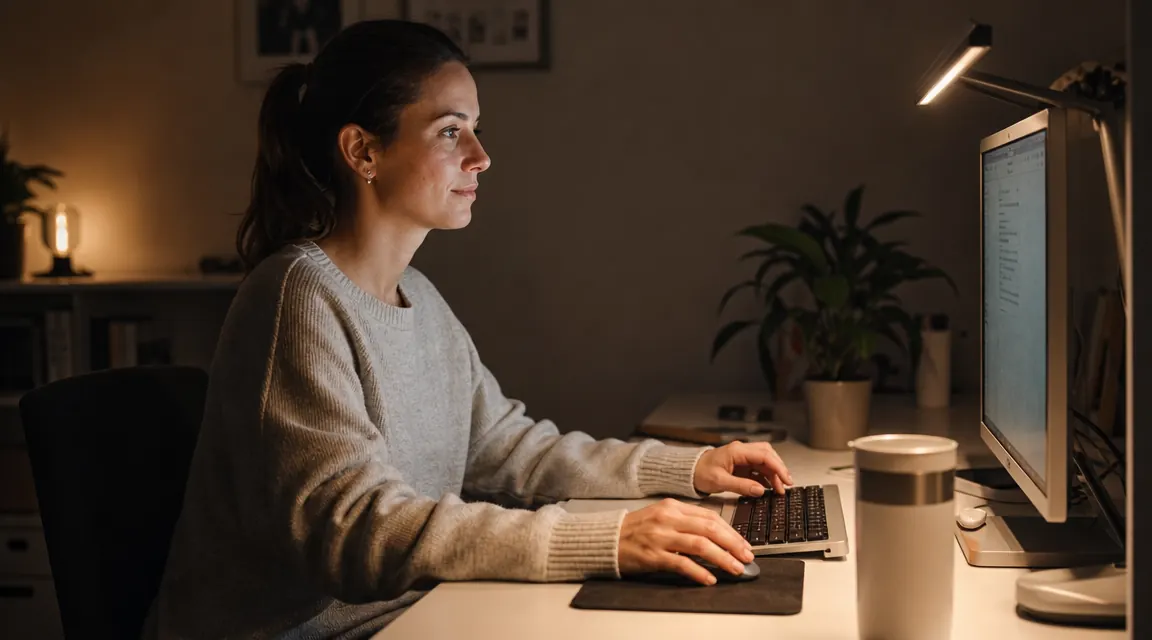
By nine in the evening my eyes feel like sandpaper. After a twelve-hour nursing shift followed by two hours of charting at my home desk, my vision goes grainy, the back of my head throbs, and I find myself squinting at my own screen. I used to think this was just the price of a long day. It is not. It is a lighting and screen setup problem, and a Quntis monitor light bar plus a few small habit changes fixed mine almost entirely without spending much money or overhauling your entire workspace.
Eye strain from screen work, technically called computer vision syndrome, affects an estimated 65 percent of Americans who spend more than two hours a day in front of a screen. The causes are specific: too much brightness contrast between your screen and the surrounding room, blue-heavy light that keeps your pupils dilated and working overtime, a monitor positioned at the wrong height or distance, and reflected glare bouncing off the screen from behind you. Fix those four things systematically and the burning and headaches largely go away. This guide walks through each fix in order, from the free adjustments you can do right now to the one small hardware upgrade that made the biggest single difference on my own desk.
If your eyes burn by 8 PM, your desk lighting is working against you
The Quntis monitor light bar shines directly onto your desk surface, not your screen, which eliminates the glare that causes late-night eye strain. Rated 4.6 stars across 13,500 reviews.
Amazon Check Today's Price on Amazon →Step 1: Lower Your Monitor Brightness to Match the Room
The most common mistake people make with eye strain is running their monitor at maximum or near-maximum brightness. Most monitors ship from the factory with brightness set to 100, which was designed for use in a bright showroom or fluorescent office. At home, in a normally lit room, that brightness level forces your pupils to constrict and your eyes to work harder to compensate.
The target is simple: your monitor should not be noticeably brighter than the wall directly behind it. A rough starting point is 40 to 60 percent brightness for a daytime home office with natural light, and 20 to 35 percent for evening work in dim lighting. Go into your monitor's on-screen menu and reduce brightness in small steps until the screen feels comfortable rather than intense. If you cannot find the on-screen menu, most monitors have physical buttons on the back or bottom edge labeled Menu, Brightness, or a sun icon.
Do not confuse this with your operating system's display brightness slider, which controls the backlight on laptops. On a desktop monitor, you want the monitor's own hardware setting, not a software overlay. Software overlays like f.lux or Windows Night Mode shift color temperature, which is helpful but separate from brightness and should come later.
Step 2: Shift Your Color Temperature to Warmer Tones in the Evening
Blue light is not the villain it is often made out to be, but it does matter at the wrong time of day. Blue-heavy light, in the 5000K to 6500K range, signals your brain that it is midday. In the evening, after a long shift, your eyes are already fatigued and that signal forces continued alertness in a visual system that is trying to wind down.
Most modern monitors have a color temperature or color preset setting in their on-screen menu. Look for a setting labeled Warm, 4000K, or Paper Mode. If your monitor does not have this, download f.lux (free) for Windows and Mac, or enable Night Shift on Mac or Night Mode on Windows. Set the warm shift to activate automatically at sunset, or manually whenever you start an evening session. The screen will look slightly yellow at first and then you will stop noticing it within a few minutes while your eyes quietly thank you.
Step 3: Position Your Monitor at the Right Height and Distance
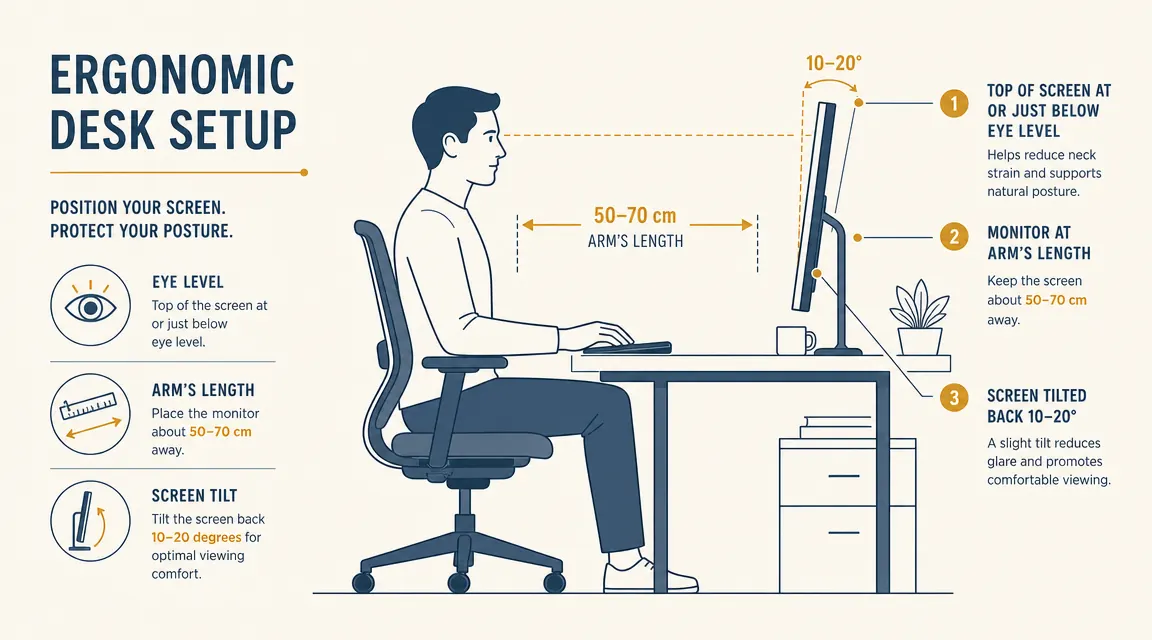
Most people sit too close to their monitor and have it positioned too high. Both errors increase eye muscle workload significantly. The correct distance is roughly arm's length, which works out to 50 to 70 centimeters or 20 to 28 inches from your face to the screen. At that distance your eyes do not have to work as hard to maintain focus. If you find yourself leaning in, either increase the font size in your browser or applications, or move the monitor closer. Do not sacrifice the distance to read small text.
Height matters equally. The top of your monitor should be at approximately eye level or very slightly below it, so your gaze naturally rests in the upper third of the screen with your chin level or slightly dropped. When a monitor is too high, your eyes are open wider than normal, which increases tear evaporation and causes dryness faster. If your monitor is sitting flat on a desk surface and you are looking up at it, a monitor arm or even a stable riser can fix this quickly. For a full guide on setting monitor height precisely, see the step-by-step walkthrough in our guide on how to mount a monitor arm for neck relief.
Also check your screen tilt. A monitor that faces straight up perpendicular to the desk is wrong. The screen should tilt back 10 to 20 degrees from vertical, so the face of the screen is angled slightly toward you rather than presenting a flat plane. This reduces the viewing angle overhead glare reaches the screen surface.
Step 4: Eliminate Glare Sources Behind and Beside You
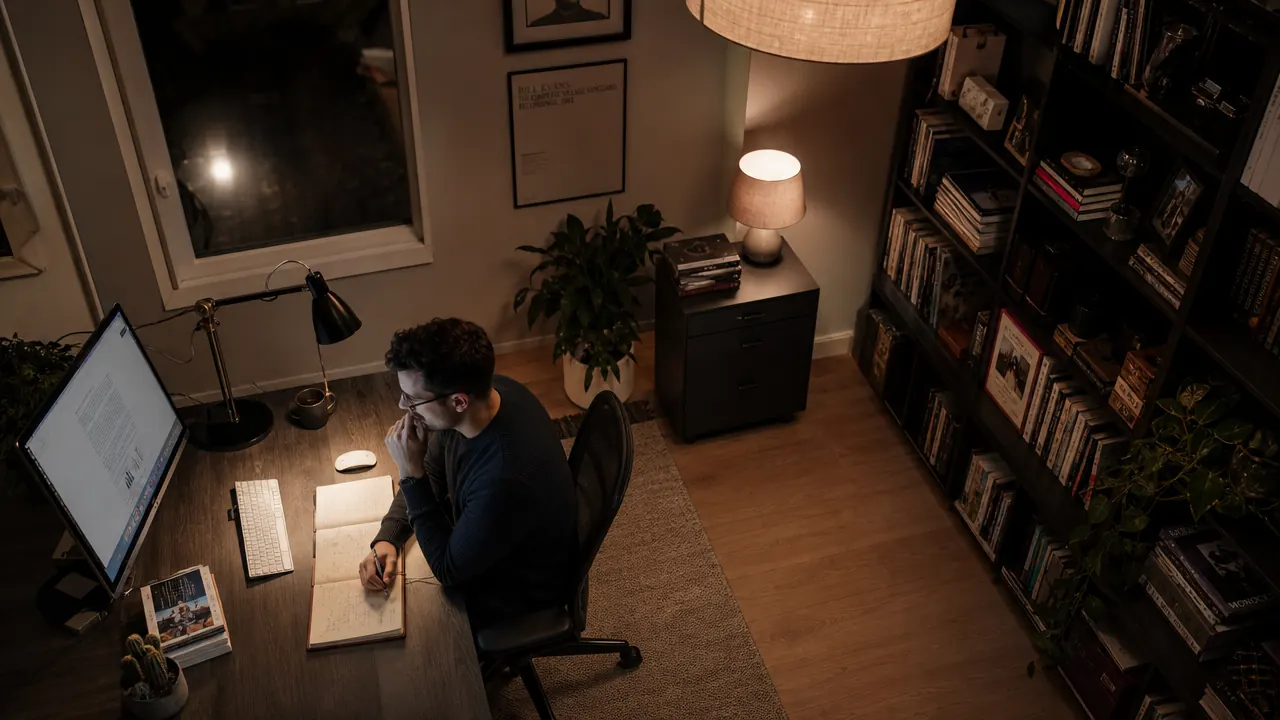
Glare is the leading cause of eye strain for home office workers and also the most invisible because you are rarely looking directly at the glare source. You are looking at your screen, but your eyes are simultaneously processing the reflection of a bright window or overhead light in the screen surface. That split-signal processing is exhausting.
Do this test right now: turn your monitor off and look at it. If you can see a reflection of a window, a ceiling light, or a lamp behind you, that is what your eyes are fighting every time you work. The fixes are ranked by effectiveness. First, position your monitor so windows are to your side, not behind you. A window directly behind you casts your own silhouette into the screen as a dark shadow and floods the screen surface with daylight. Second, if you cannot move, use blinds or curtains to control window brightness. Third, use a matte screen protector if your monitor has a glossy panel. Glossy monitors look beautiful in a store and are a nightmare for glare in real rooms with real lighting.
Turn your monitor off right now and look at the screen. If you see a window reflection, you have found your biggest source of eye strain.
Step 5: Add a Focused Desk Light That Does Not Hit the Screen
This is the step most guides skip, and it is the one that made the biggest actual difference on my desk. Even after fixing brightness, color temperature, monitor position, and glare sources, I still had a core problem: when I worked in the evening with only the monitor on, there was a dramatic brightness gap between the bright screen and the dark room around it. Your eyes constantly adjust for that contrast as they move from screen to keyboard to notepad and back. That constant micro-adjustment is what causes the burning and heavy feeling by the end of the night.
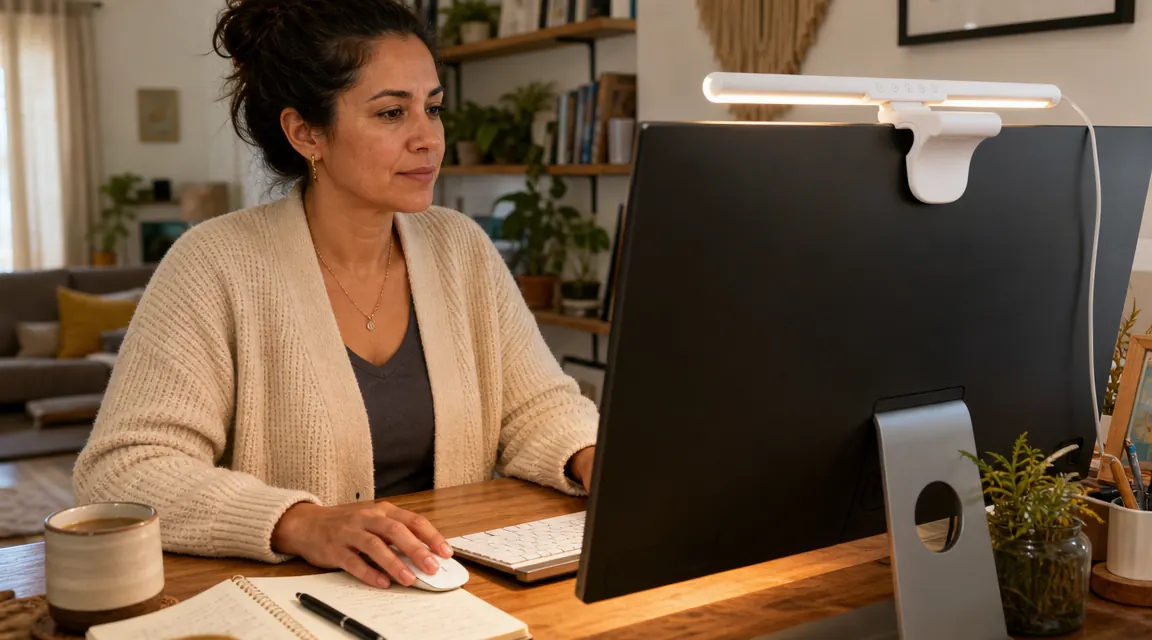
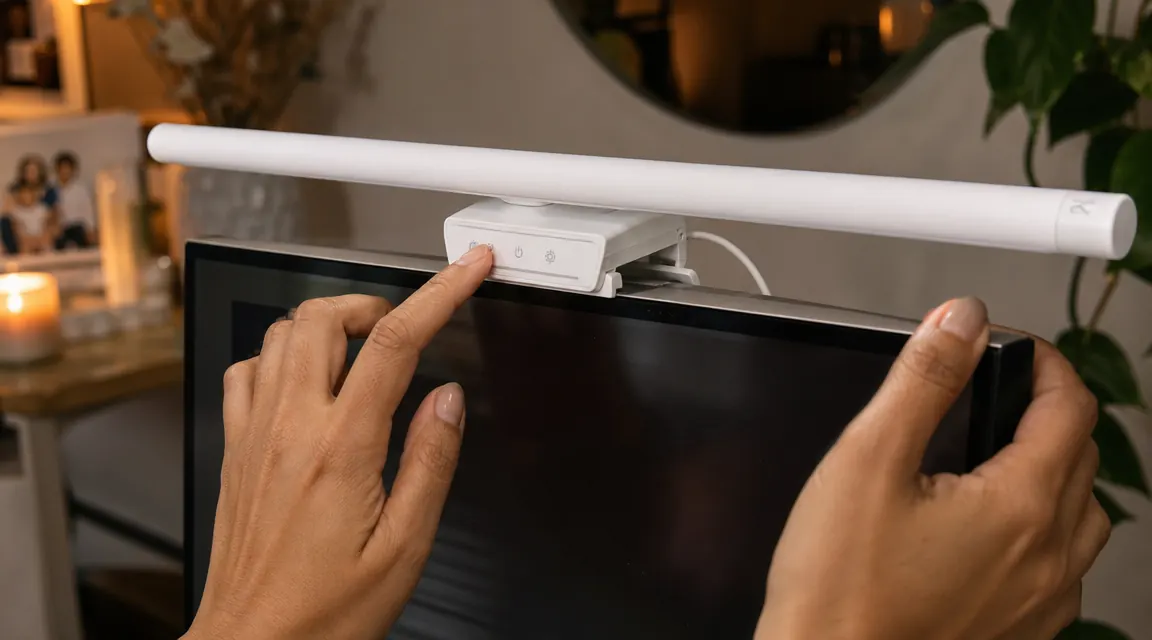
The solution is to add ambient light around the monitor that brings the background brightness closer to screen brightness, without adding more light that bounces off the screen surface itself. A standard desk lamp solves some of this but creates its own glare because it shines light in multiple directions including toward the screen. A monitor-mounted light bar is designed specifically for this problem. It sits on top of the monitor and shines light downward onto the desk surface using an asymmetric lens, meaning the light goes forward onto the keyboard and desk and does not project backward onto the screen at all.
I have been using the Quntis Computer Monitor Lamp on my desk for the past year. It clips onto the back of my monitor's top edge with a counterweight, draws power from a USB-A port, and has a touch strip on the top for brightness and color temperature. The asymmetric optics genuinely work. I have a glossy monitor surface and even with the lamp running at full brightness, there is zero reflection visible on screen. It has two color temperature settings, warm (around 3000K) and neutral (around 5000K), and a continuous brightness range. At my evening setting of warm and about 40 percent brightness, it raises my desk ambient light enough that the contrast gap with my screen disappears.
The Quntis is rated 4.6 stars across more than 13,500 reviews, which is one of the strongest ratings in this category. The one limitation I have noticed is that the touch controls are sensitive enough that I occasionally brush them when reaching for something on my desk, but you get used to where it sits. For a detailed breakdown of how it compares to the more expensive BenQ ScreenBar, see the full comparison article. For a deeper look at the long-term experience, the Quntis monitor light bar long-term review covers a full year of evening use.
What Else Helps
Once you have the five steps above in place, a few smaller habits keep eye strain from coming back. The 20-20-20 rule is worth following: every twenty minutes, look at something twenty feet away for twenty seconds. This lets your eye's focusing muscles relax rather than staying locked at screen distance for hours. Set a phone timer if you need the reminder. It takes about three days before it becomes automatic.
Blink rate drops significantly when you are focused on a screen, sometimes by as much as 60 percent below normal. Conscious blinking helps. Keep preservative-free artificial tears at your desk if you work long sessions in forced air heating or air conditioning, both of which dry out eyes faster. Eye drops are a cheap and underused tool for anyone who has dry, gritty eyes by mid-evening.
Prescription glasses wearers should ask their optometrist about computer glasses. These are lenses optimized for the 20-to-28 inch focal distance rather than distance or reading, and they reduce the constant accommodation effort your eyes make at screen distance. If you wear progressive lenses, you are likely tilting your head slightly upward to look through the correct zone of the lens, which also contributes to neck and eye fatigue. Computer single-vision lenses eliminate that entirely.
The fastest single fix: light your desk, not your screen
The Quntis monitor light bar takes five minutes to set up, draws power from any USB port, and shines light precisely onto your desk surface without adding screen glare. At its current price, it is the highest-impact desk upgrade under $40 for evening workers.
Amazon Check Today's Price on Amazon →